
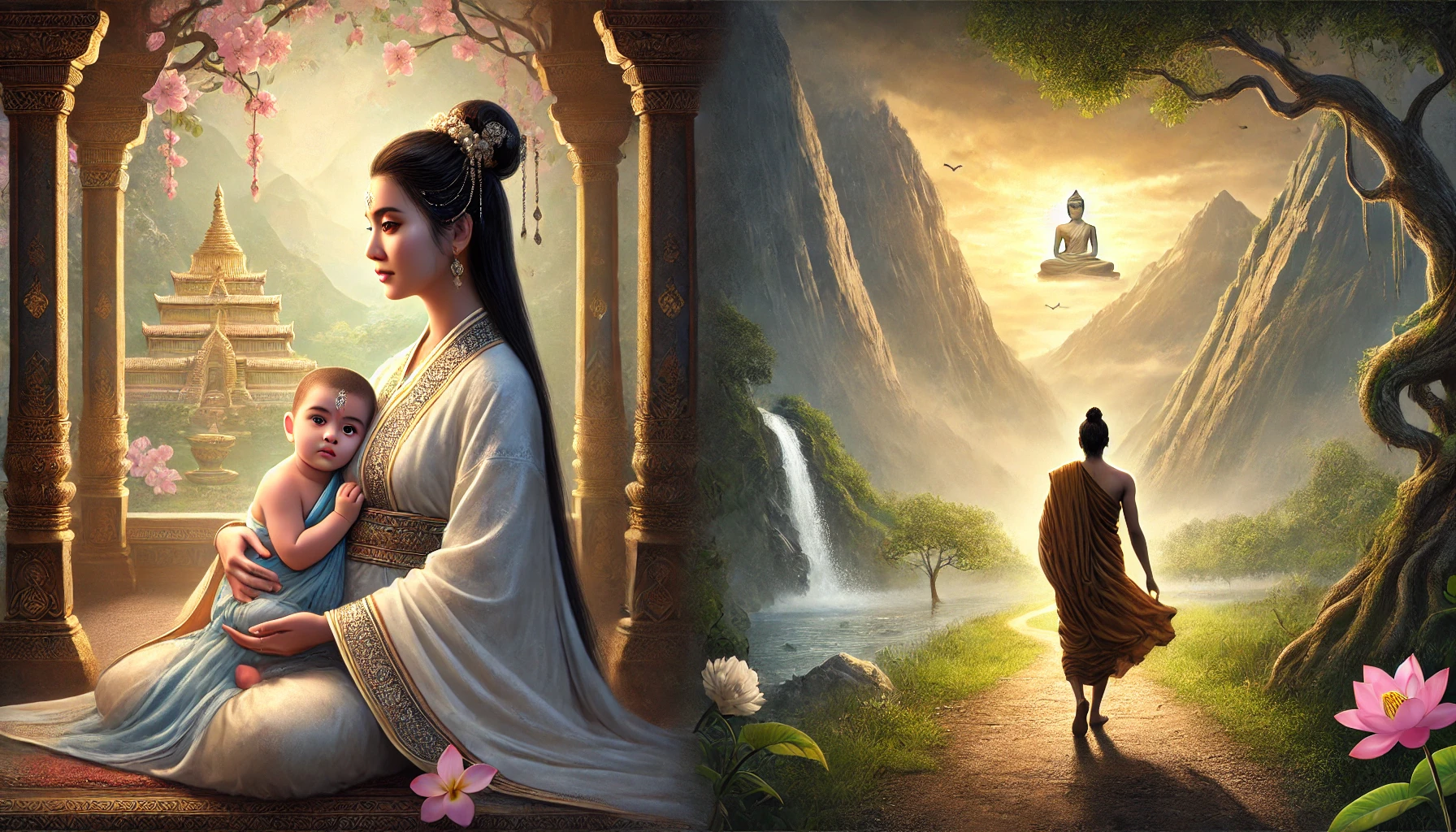
To represent Yasodhara’s Journey vs Siddhartha’s Path, the image is divided into two contrasting yet harmonious sections, symbolizing the journeys of both Yasodhara (Buddha’s wife) and Siddhartha (Buddha himself).
- Left side (Yasodhara’s Journey): Depict Yasodhara dressed in flowing traditional robes, standing in a serene palace courtyard, surrounded by soft light and nature. Her expression is contemplative yet peaceful, symbolizing inner strength and quiet resilience. The background shows her caring for a child (Rahula, her son) with subtle hints of sorrow yet grace, representing her spiritual awakening in his absence.
- Right side (Siddhartha’s Path): Show Siddhartha Gautama in his ascetic robes, walking towards enlightenment. This half features an outdoor scene with rugged mountains, a flowing river, and a distant Bodhi tree. His path is difficult but illuminated by a golden light, symbolizing awakening as he walks with determination toward enlightenment.
The image contrasts Yasodhara’s silent strength at home with Siddhartha’s arduous journey toward spiritual awakening.
The story of Yasodhara and Siddhartha Gautama offers a profound exploration of two complementary paths toward spiritual awakening. While Siddhartha, the historical Buddha, leaves the palace in pursuit of enlightenment, Yasodhara embodies the power of silent resilience, spiritual growth within community, and the transformative potential of motherhood. This dual narrative provides insight into how personal awakening can take diverse forms — one through renunciation and solitude, the other through engagement, relationships, and emotional maturity. Understanding both perspectives enriches our appreciation of the spiritual journey, highlighting that enlightenment is not a singular path but a spectrum of inner growth.
Yasodhara’s Journey vs Siddhartha’s Path
| Aspect | Yasodhara’s Journey (She Who Stays) | Siddhartha’s Path (He Who Leaves) |
| Catalyst for Journey | Siddhartha’s departure and the birth of their child, Rahula | Witnessing suffering (old age, sickness, and death) during his travels outside the palace. |
| Primary Focus | Staying connected with her community, family, and child while seeking spiritual growth. | Detachment from worldly attachments and renunciation of family to seek enlightenment. |
| Path to Enlightenment | Through relationships, motherhood, and community support (women’s sangha). | Through solitary meditation, asceticism, and a focus on personal awakening. |
| Emotional Struggles | Abandonment, grief, and loss, while finding strength through connection. | Isolation, self-doubt, and struggle with the temptations of worldly desires. |
| End Result | Achieves spiritual awakening within a supportive, relational community. | Achieves enlightenment under the Bodhi tree through self-reliance and solitary reflection. |